1) Assessing the Impact of Digital Banking Adoption on SME Financing Access and Performance 2) Predictive Analytics for Credit Risk Assessment Using Explainable AI in Retail Banking 3) Evaluating the Role of FinTech Partnerships in Enhancing Payment Systems and Financial Inclusion 4) A Study on Liquidity Risk Management and Stress Testing under Macro-Financial Shocks 5) Analyzing the Effects of ESG Integration on Portfolio Performance and Risk 6) Development of a Customer-Centric Personal Finance Management Tool Using AI 7) The Effectiveness of Central Bank Digital Currencies (CBDCs) in Monetary Transmission Mechanisms 8) Risk-Based Pricing in Microfinance Institutions: A Comparative Study 9) Impacts of Interest Rate Pass-Through on Household Debt Servicing in Emerging Markets 10) Blockchain-Based Trade Finance Solutions: Efficiency, Compliance, and Risk Implications
Table Of Contents
Chapter ONE
INTRODUCTION
- 1.1Introduction
- 1.2Background of Study
- 1.3Problem Statement
- 1.4Objective of Study
- 1.5Limitation of Study
- 1.6Scope of Study
- 1.7Significance of Study
- 1.8Structure of the Research
- 1.9Definition of Terms
Chapter TWO
LITERATURE REVIEW
- 2.1Theoretical Foundations and Concepts in Digital Banking
- 2.2SME Financing and Access to Credit: Trends and Gaps
- 2.3Digital Payment Ecosystems and FinTech Collaboration
- 2.4Regulatory and Compliance Considerations in Digital Banking
- 2.5Consumer Behavior and Adoption of Digital Banking Services
- 2.6Credit Risk Modeling Theories and Explainable AI
- 2.7Liquidity Risk and Stress Testing Frameworks
- 2.8ESG Integration in Banking and Portfolio Management
- 2.9Central Bank Digital Currencies: Policy and Implementation
- 2.10Case Studies: Digital Banking Transformation in Emerging Markets
Chapter THREE
RESEARCH METHODOLOGY
- 3.1Research Design and Philosophy
- 3.2Population and Sampling Techniques
- 3.3Data Collection Methods
- 3.4Data Sources and Instrumentation
- 3.5Variable Definition and Measurement
- 3.6Model Specification and Estimation Techniques
- 3.7Validity, Reliability, and Reliability Testing
- 3.8Ethical Considerations and Data Privacy
- 3.9Limitations and Delimitations
- 3.10Project Timeline and Milestones
Chapter FOUR
DATA PRESENTATION AND ANALYSIS
- 4.1Descriptive Analysis of Digital Banking Adoption
- 4.2SME Financing Access Metrics and Performance Indicators
- 4.3Payment Systems Efficiency and FinTech Collaboration Outcomes
- 4.4Liquidity Risk Profiles under Macro-Financial Shocks
- 4.5Credit Risk Assessment: Model Development and Validation
- 4.6Explainability and Interpretability of AI-Based Credit Models
- 4.7ESG Integration: Effects on Portfolio Risk and Return
- 4.8Policy Implications and Practical Recommendations
Chapter FIVE
SUMMARY, CONCLUSION AND RECOMMENDATIONS
- 5.1Summary of Findings
- 5.2Theoretical and Practical Implications
- 5.3Conclusions Drawn from the Study
- 5.4Recommendations for Stakeholders
- 5.5Limitations of the Study and Future Research
- 5.6Contributions to Theory and Practice
- 5.7Final Reflections
Project Abstract
This study investigates how digital banking adoption influences SME financing access and performance, and extends to predictive analytics for credit risk in retail banking, the role of FinTech partnerships in payment systems and financial inclusion, liquidity risk management under macro-financial shocks, ESG integration effects on portfolio performance and risk, development of an AI-driven personal finance management tool, CBDCs' effectiveness in monetary transmission, risk-based pricing in microfinance, impacts of interest rate pass-through on household debt servicing in emerging markets, and blockchain-based trade finance solutions in terms of efficiency, compliance, and risk. The research adopts a multi-method, mixed-design approach across five interconnected layers. First, a macro-to-micro analysis examines how digital banking penetration shapes SME credit access, leveraging bank-level lending data, fintech-enabled credit platforms, and SME outcome metrics (growth, survival, repayment quality). A concurrent module develops and validates Explainable AI (XAI) models for retail credit risk assessment, ensuring transparency, fairness, and regulatory compliance through interpretable feature importance, SHAP analyses, and scenario testing under evolving credit cycles. Second, the study evaluates FinTech collaborations in payments by mapping partnership models (bank–fintech ecosystems, API-enabled rails) and measuring outcomes in payment efficiency, inclusion indicators for under-banked segments, fraud/operational risk, and customer experience. Third, liquidity risk management is explored through stress-testing frameworks under macro-financial shocks, assessing interbank funding dynamics, liquidity-adjusted value-at-risk, and the resilience of liquidity buffers with policy implications for central banks and regulators. The ESG-portfolio strand analyzes the linkage between ESG integration and risk-adjusted performance, drawdown behavior, factor exposure, and compositional stability across asset classes, using time-series and cross-sectional asset pricing tests; this is complemented by sensitivity analyses to different ESG data providers and rating methodologies. The AI-driven personal finance management tool is prototyped and pilot-tested with consumer cohorts to evaluate behavioral nudges, budgeting accuracy, savings propensity, and financial well-being outcomes. Further, the study investigates CBDCs as monetary transmission channels by modeling transactional velocity, interest rate pass-through, and bank funding costs under different CBDC designs, including retail-focused and wholesale-centric implementations. Microfinance pricing models are empirically compared to identify risk-based pricing determinants, borrower selection efficiency, and repayment performance. The impacts of interest rate pass-through on household debt servicing are examined in emerging markets, accounting for currency risk, income volatility, and debt composition. Finally, blockchain-based trade finance solutions are evaluated for efficiency gains, compliance with KYC/AML and trade finance regulations, and risk-transfer implications. Data sources include central banks, commercial banks, fintech platforms, macroeconomic databases, and panel datasets from microfinance institutions. The research employs econometric techniques (panel regressions, difference-in-differences, VARs), machine learning with robust fairness and explainability protocols, network analysis for payment ecosystems, and scenario-based stress testing. Policy implications target financial inclusion, regulatory frameworks for AI and CBDCs, risk management practices, and strategic guidance for banks and fintechs seeking sustainable, resilient, and inclusive financial systems.Project Overview
What This Project Is AboutThe project explores how modern banking tools and technologies affect everyday financing, risk, and money management. It spans topics from digital banking for small businesses to AI-driven risk checks, fintech partnerships, and emerging payment and monetary systems. Each topic looks at practical benefits, challenges, and real-world implications for individuals, businesses, and financial institutions.
The Problem It Addresses
Objectives of the Project
- Explain the main idea and relevance of each topic in simple terms.
- Identify key benefits and risks for customers and banks.
- Outline potential methods or tools used in the field without technical jargon.
- Provide a clear summary of how innovations impact access to finance and financial stability.
What You Will Do Step by Step
- Explain the main idea and relevance of each topic in simple terms.
- Identify key benefits and risks for customers and banks.
- Outline potential methods or tools used in the field without technical jargon.
- Provide a clear summary of how innovations impact access to finance and financial stability.
What You Will Do Step by Step
1) Choose one topic of interest from the list. 2) Do a literature scan to find real-world examples. 3) Map out who benefits and who might be harmed. 4) Describe simple methods to study the topic (e.g., case reviews, basic data checks). 5) Present findings with practical implications and clear recommendations.
Expected Outcome
A concise, beginner-friendly report that explains the topic, highlights practical implications, and offers straightforward recommendations for students, practitioners, and policymakers.
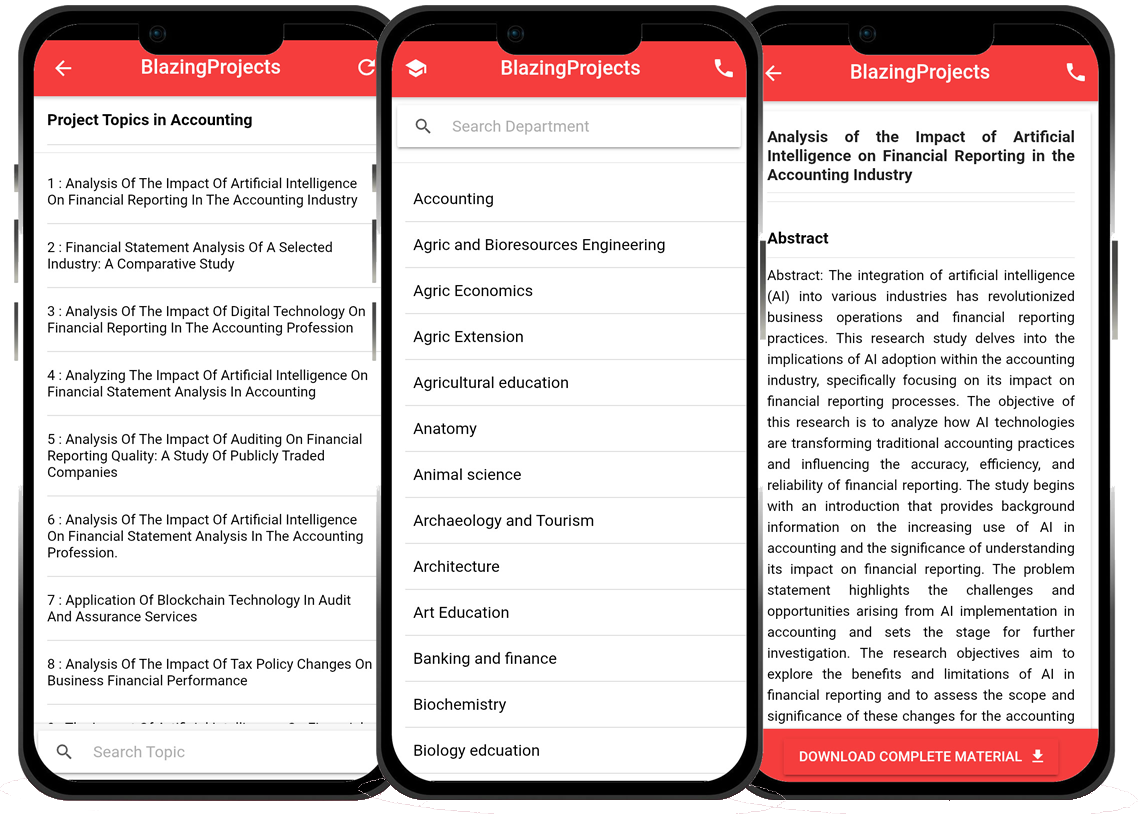
Blazingprojects Mobile App
📚 Over 50,000 Project Materials
📱 100% Offline: No internet needed
📝 Over 98 Departments
🔍 Software coding and Machine construction
🎓 Postgraduate/Undergraduate Research works
📥 Instant Whatsapp/Email Delivery
Related Research
- Assessing the Impact of Central Bank Digital Currencies on Cross-Border Settlement...
What This Project Is About A plain-language overview of how digital forms of money issued by a central bank might change how money moves across borders and how ...
1) Assessing the Impact of Digital Banking Adoption on SME Financing Access and Perf...
What This Project Is About The project explores how modern banking tools and technologies affect everyday financing, risk, and money management. It spans topics...
Impact of Digital Banking Adoption on Financial Inclusion and Customer Profitability...
What This Project Is About A plain-language overview of how digital banking changes access to financial services and how it affects customer profitability for b...
Impact of Central Bank Digital Currencies on Commercial Bank Profitability and Risk ...
What This Project Is About A plain-language overview of how central bank digital currencies (CBDCs) might affect how banks earn money and manage risk. The proje...
Impact of Open Banking on Retail Banking Revenue and Customer Experience: A Comparat...
What This Project Is About A plain-language overview of how open banking allows customers to share financial data securely with third-party providers and how ba...
Impact of Real-Time Payments on Retail Bank Liquidity Management and Customer Experi...
What This Project Is About A plain-language overview of how real-time payments affect how banks manage funds (liquidity) and how customers experience payment se...
Impact of Open Banking on Consumer Credit Access in Emerging Markets: A Data-Driven ...
What This Project Is About A straightforward, beginner-friendly look at how open banking—the sharing of financial data with trusted third parties—might affe...
Impact of Central Bank Digital Currencies on Financial Inclusion and Monetary Policy...
What This Project Is About A plain-language overview of the topic and what the project investigates. The Problem It Addresses What problem or gap this project ...
Impact of Digital Payment Adoption on Financial Inclusion and Bank Profitability: A ...
What This Project Is About A plain-language overview of how digital payments affect who can access financial services and how banks earn money, comparing multip...
